Predictably Unpredictable

My agenda is like anyone else’s these days, to find better ways of understanding and making better decisions in a world where recent experience suggests we are failing to get to grips with the existential poly-crises facing us and maybe some meta-crisis that might underly these. My focus being the latter, means my interest is unashamedly abstract and conceptual, philosophical and even metaphysical, rather than the physical and human world details of any one crisis. Although I obviously engage with these too, as empirical examples.

One way or another my own deliverable contribution is a better “model” of the world, how it works and what we can know and predict about it. So, both ontological and epistemological, and it so happens, with an information-process-relational metaphysics rather than a conventional object view of things. That’s a whole thesis I won’t attempt to elaborate here.

One thing’s clear, if we’re talking about how “we” best understand and deal with global polycrises, we’re talking about systems and situations as complex as conceivable. Populations of psychologically intentional human agents, with aspirations and foibles, individually and in any number of overlapping groups and organisations, interacting as part of our local and cosmic ecosystems. There can be nothing more complex. Life, the universe and everything as I often say. And, as I posted recently, it is moot whether we talk primarily in terms of “systems” or “complexity”. We need the pragmatism to recognise both communities of ideas, all societies of minds. Requisite diversity.

Although my thesis is vast, commensurate with the topic and mostly nothing new under the sun, I have for a couple of years been blocked by one important assertion that fails to stick. I do regularly get people to agree that we’re talking about “more than science“, but as soon as discourse proceeds to preferred theories, models, frameworks and methods, those same people almost invariably continue to talk exclusively in terms of, this, that or the other “science(s)”. I say “Systems Thinking” some insist on “Systems Science(s)”. Why? baffles me.

Now, there’s nothing “anti-science” or “post-modern” here. I’m an engineer grounded in the physical sciences and the closing summary from my last significant presentation on the topic is “as scientific as possible”. So-called “3rd culture” – post-post-modern (PoPoMo) – if anything. I’m simply saying, faced with such complex realities, it is more honest to recognise that our knowledge, decision-making and actions must involve more considerations than the sciences.

Who is Our Audience?

Now, any theorist or specialist practitioner in the Complex Adaptive Systems space, and indeed any practitioner in the sciences generally, will recognise as we go from from physical sciences to biology to psychology that predictability and repeatability get less and less, even if all the processes and content are scientifically explicable. We – specialists – don’t stop calling them science, we just accept that the predictable outcomes on which we base our best decisions with the best information currently available get less and less certain, and that how certain may get less and less quantifiable. We may even adopt stochastic and participation-led methods and heuristics that recognise previously experienced patterns of uncertainties.

But this is a one-dimensional view of uncertainty in the real world and there are more meta-levels to consider in more abstract conceptual dimensions. (Using real and conceptual in a natural language sense here, obviously any eventual ontology will address these too.) Some many-layered emergent outcomes are only predictable in kind and in patterns of kind – that is at multiple conceptual levels removed from the actual. Individual real-world outcomes are not usefully predictable at all. Actual decisions depend not just on the available science and objective evidence, formally modelled and empirically documented, but also on the trusted judgement and the situated-&-embodied experience of the humans involved in context. Wisdom in a word.

Now whilst systems and complexity-scientific specialists can all understand where predictability of outcomes become less and less valuable, compared to recognising that which emerges into the real world from the evolutionary processes at both conceptual and real levels, with only limited enabling and guidance – creative constraints – we are not really our own audience.

The real audience needed, if sophisticated systems and complexity considerations are to help with real world actions to solve our existential polycrises, are politicians, leaders and servants in organisations and governments, judiciary, journalists and – in democracies – public electorates.

Without the acknowledgement and acceptance that “good decisions” require those aspects more than science above, the enormous success of science to date means these constituent audiences have become trained to expect only objective evidence and causal logic to back up proposed actions. No trust without these.

So What’s New?

Yesterday at short notice I attended a Complexity Lounge talk by Chris Mowles, Professor at the Complexity and Management Centre at the University of Hertfordshire. From the introduction I picked-up a question directly related to my agenda above:

“A radical interpretation of the complexity sciences”
[and]
“things we aspire to, but even our aspirations will evolve and change in our interactions with each other and the world.”

Suggesting that maybe we could agree the latter – interactively evolving aspirations – were “more than science”? If unpredictability is all we can predict, we need more than (scientific) predictions to make good decisions?

I found it a very refreshing take from Chris. Many sources beyond complexity sciences – ethical politics, philosophical pragmatism and literature. I didn’t make enough notes, so I will need to pick-up the slides from the recording – see post note below.
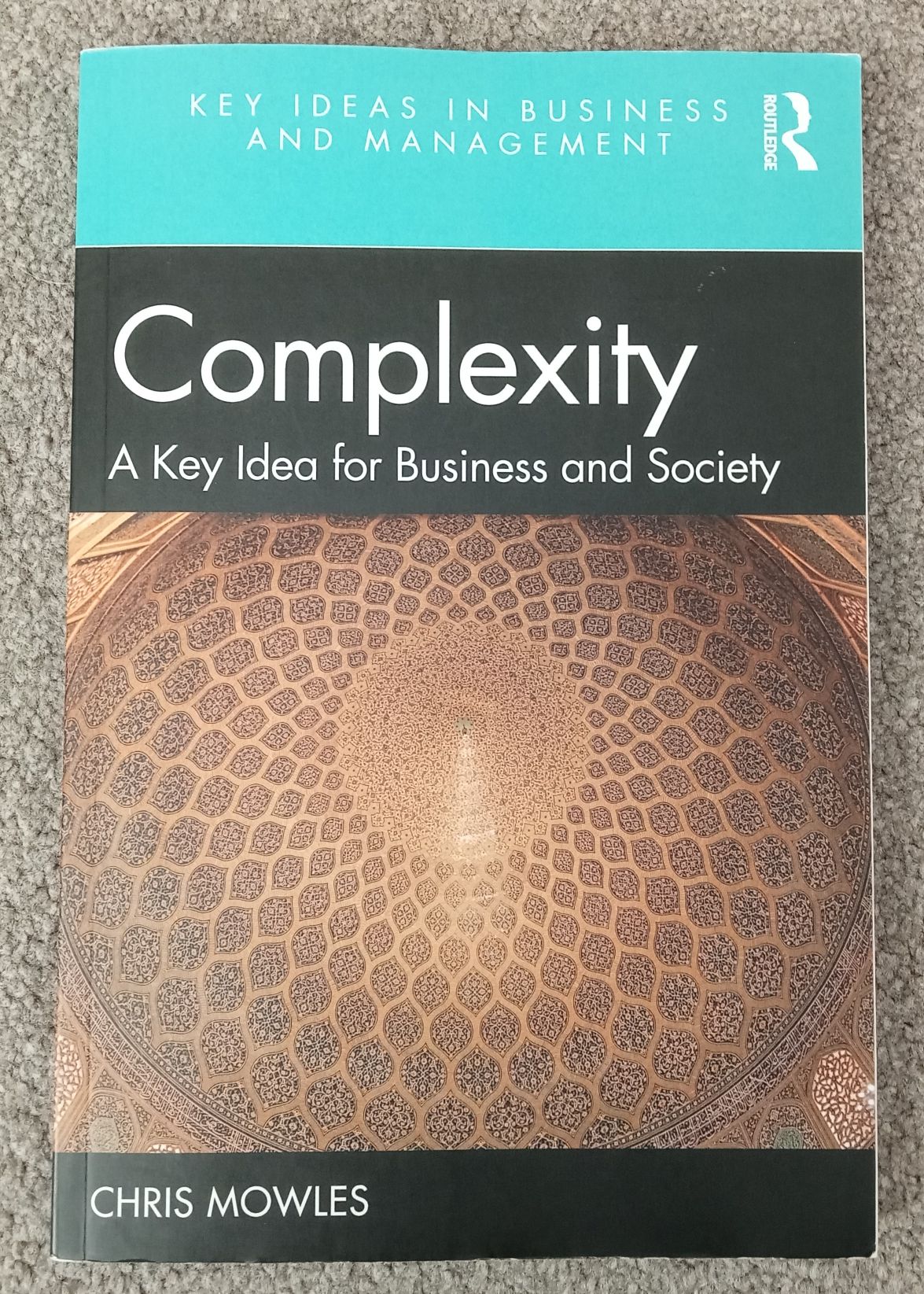
What I did do is I already obtained a copy of his “Complexity – A Key Idea for Business and Society“. The “and” in the sub-title is key. The chapter headings are all I could hope for. More later no doubt – further reference after reading, here.

=====

Post Notes:

Here’s the YouTube recording (embedding blocked).

Chris also has his own blog.

As well as being active on LinkedIn.

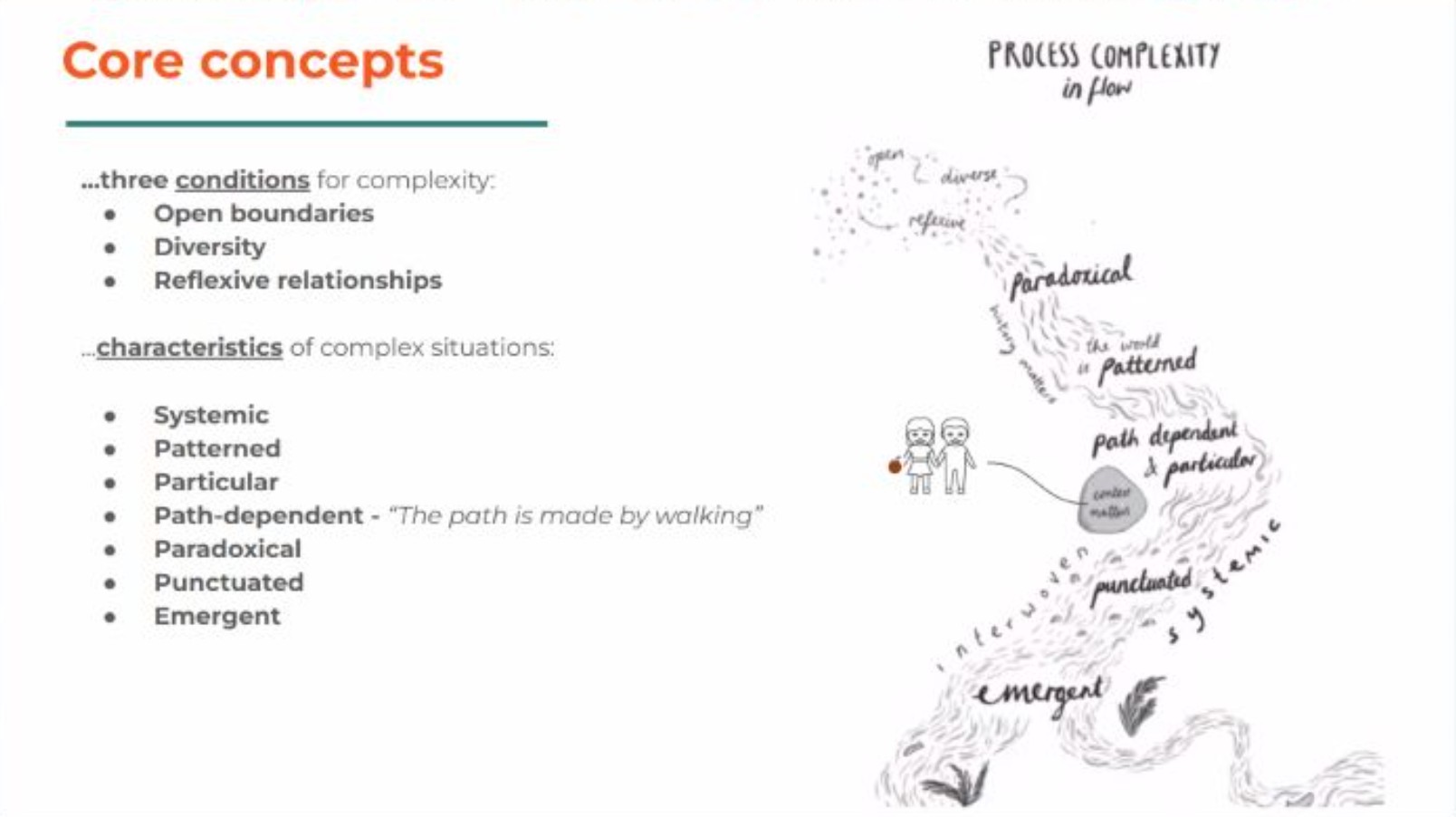
And, here is a PDF of Chris’ slide deck.

=====
Systems vs Complexity

Mentioned several times that, within the Systems Thinking community in its widest sense, there are factions that don’t just have preferred views, they positively reject others.

Even within those that see Systems as the main focus, there are competing theories, sciences and methodologies, as well as competing and complementary world-views on multiple dimensions. A large part of my own recent agenda has been to emphasise the recognition that our knowledge of systems and their practical implementations involves more than science – wisdom for short-hand convenience – whichever of the theories or sciences are preferred. The practical views are ultimately Pragmatism by any other name, and Mike Jackson’s comprehensive contribution also emphasises this (last section of a long diary post).

I say “even” because there are factions that reject the language of Systems entirely in favour of Complexity sciences and methods. Most systems thinkers see their thinking as a response to complexity, whatever definition of systems, or preferred theories and methods we espouse. No systems thinker would reject the significance of complexity to their discipline. Those who espouse complexity rather than systems have identifiable reasons. The two examples I’m going to use are Jean Boulton (The Tao of Complexity) and Dave Snowden (Cynefin) and their rejection of systems in favour of complexity might be all they have in common.

The first reason is quite straightforward. Naming things as systems – a system or the system – with specific identity and characteristics – objectifies & reifies them implying well-defined, possibly static, boundaries. The first of Boulton’s conditions (below) is exactly this. All systems in the cosmos are open systems except – by definition – for the cosmos itself. Naming, drawing a #GoodFence as a boundary around any given system of interest, is always a pragmatic linguistic convenience. Drawing a boundary needn’t imply that it is impervious to systemic activity.

A second reason is in the definition of what we mean by “system”. We can start with Boulton’s second and third conditions – diversity and reflexive relationships. Any system of interest has multiple different elements – requisite diversity – and that these are functionally related to each other and to other systems. The three conditions are met by just about any systems definition.

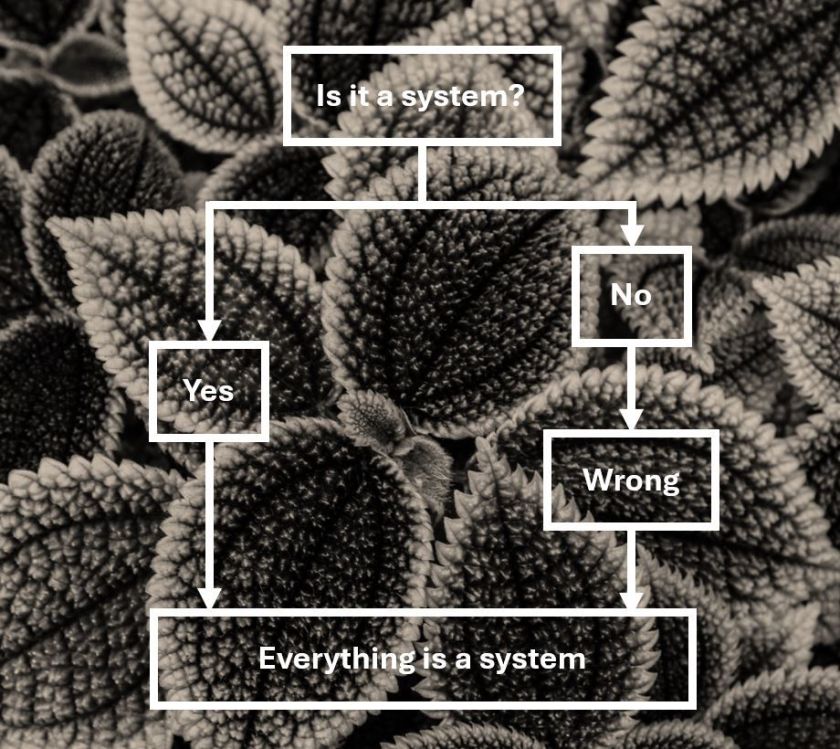
A corollary, and third reason arising from the second, is that anything and everything can be considered as a system in those terms.

[From Jo Kaybryn on LinkedIn]

Which is all encompassing of life, the universe and everything, so thinking of something as a system doesn’t narrow down our scope of interest. It’s almost redundant to refer to something as a system if everything is a system. Which is probably another reason why Snowden rejects the language.

But, in fact, System is practically just an adjective for thinking in terms of functional relations. Systemic Thinking if you prefer. And ISSS Past President, George Mobus also presents “A General Theory of Systemness, proposing that we look at the essential characteristics of being a system rather than debate endlessly what does or doesn’t count as a system.” [recent ISSS Newsletter] Precisely! The characteristics of systemness that make something systemic – rather than needing to agree the definition of a system – whether we call “it” this or that system or not. [To emphasise the dynamic, verb or adverb rather than noun or adjective Rasmussen suggests “Systeming” – what systems do.]

Pragmatically, the preference for complexity and/or systems language is a non-event. We all need complexity and dynamic functional systemness or systemicity.

=====

[Note: – the idea of #GoodFences and identity-defining-boundaries is a whole subject in itself here on Psybertron.]

=====

Post Note: Dave Snowden’s own writing continues, here via LinkedIn.

He’s OK with Systems as “Complex Systems” – which is about where I am, obviously. His use of the word “substrate” illustrates his (correct) architectural distinction that much of what matters at the human level primarily emerges from and supervenes on the physical as creative constraints, not in any way reductively causal. And in an earlier post he’s complaining about fashionable misuse of Pragmatism – between natural language pragmatism and the US Pragmatists – I’m already on it. And I notice a few converging threads. Another round of people thinking they are “debunking” Maslow (they’re really not), some conversely suggesting there’s a layer of “Transcendence” above Self-Actualisation and Dave railing against Transcendence. All good fun.

People confuse short-hand with precision – really just a language game #GoodFences (again).

=====

Cynefin 2025

I make multiple references (as far back as 2003) to Dave Snowden and his “Cynefin” sensemaking – organisational strategic action consulting business. My interests remain more abstract philosophically – metaphysical – but even with differences of shared understanding at this level, and indeed his personal style & preference level, I am nevertheless a “fan boy” at the level of his practical participatory approach(es).

I said as much in the post from early this year, in which I also included my favourite version of his Cynefin Framework diagram. This has evolved in detail over the years, particularly in the labelling / annotation language, but despite appearances has maintained its distinction from the Boston Consulting 2×2 grids, ubiquitous in management consulting space. However many dimensions our real problem space, any view on page or screen is a 2D projection, with its own orthogonal axes, so this isn’t a criticism. But seemingly simple views – for understandable reasons of intended problem simplification – often lead the unwise to simplistic understandings and decisions. The Cynefin diagram always maintained the clue that we weren’t looking at a single contiguous plane. The aporetic gap / hole.

The focus was always complexity, so that different “sciences” (*) and approaches could be brought to various Simple > Complicated > Complex > Chaotic domains, but that has become a given, with all “Systems Thinking” being seen as a response to complexity. Snowden has multiple other working views and approaches as well as his framework overview – documented more and more in his prolific writing. The reason for this post is to capture a copy of a new overview that has been shared increasingly – e.g. on LinkedIn – over the summer.

I like it, even if I haven’t fully digested it or Snowden’s intent. The language in the boxes will no doubt evolve with context, but those two axes and all ten words of their labels seem to hit their targets.

The fine- and coarse-graining of interventions, the natural (externally) and (internally) stimulated emergence of new species (of whatever we’re interested in). And, the four levels of complication replaced with the simpler (Ha!) ordered vs complex distinction. Ha!, because all distinctions (#GoodFences / lines drawn, that diagram has several) are simple-looking binary dichotomies in our ontologies, however much we wish to avoid them being “unnecessarily” divisive in our real-world problem space.

The previous vertical divider between ordered (simple / complicated) and complex (complex / chaotic) is now mapped as the red arc, and the aporetic gap is now smeared and swept around the whole – partially turned inside-out?

Also having mentioned dichotomies, I notice Dave is pushing several triadic views. The dichotomies at fundamental levels of abstraction (ontologies) don’t go away, but any number of more practically useful views are constructed from these.

=====

(*) I say “sciences” in scare quotes, because a significant part of my philosophical systems agenda is that there is “more than science” (first link here) that matters 🙂

And I notice the latest graphic above is being shared in connection with his “Estuarine Mapping” methodology. Picked-up on that as an interesting concept a couple of years ago, but never followed its detailed development since. An omission.

=====

Post Note: Slight change of topic – but reminded of something I didn’t respond to at the time. A month or so ago, since the Birmingham ISSS2025 dialogues, Dave made some LinkedIn comments about styles of argumentation. He’s often quite pedantic about being quoted literally rather than any attempt at paraphrasing or rephrasing in ones own words. Obviously “claiming” agreement with Dave on the basis of one’s own rephrasing isn’t on – and I do regularly point out that we do have disagreements (despite which, etc.) – BUT attempts at rephrasing each other are a fundamental part of dialogue towards agreeing shared understandings of a topic. “Try this”.

Obviously they’re not “agreed” until mutually agreed and it would be disingenuous to suggest so. Don’t believe I ever have?

Very much my “Rules of Engagement” topic.

And another (Oct 2025) quote on abuse of pragmatism -still sticking to his “science” guns:

The use, and too frequently the abuse, of Pragmatism (philosophy) in management theory is growing. Too much of this apologia falls foul of Russel’s criticism that Pragmatist’s theory of truth is subjective, resting on emotional satisfaction and utility rather than correspondence to an objective reality. Now most complexity science work acknowledges pragmatism, in particular abduction which is rigorous within the context of systems without material linear causality. Pearce rightly sees it as the foundation of science. But it is rigorous, not an excuse to justify the abusive ‘I think it worked for me last time so it must be universally true’. One indicator is if the references are to Peirce & Quine or James & Dewey and/or an attempt to oppose what is too often a strawman characterisation of natural science.

It is of course Russell’s view of science I am rejecting. And, talking of strawmen ‘I think it worked for me last time so it must be universally true’ would be a good example 🙂 Incorrigible.

And another (Oct 2025) pragmatic reality quote from Dave:

I doubt anyone creating a frame would hold it to be universal. Any framework carries and should declare both ontological and epistemological assumptions. But language is itself a framework that constrains conversational interaction. Some frameworks (semiotics for example) provide ways to de-territorialise those constraints. It’s all a lot more messy and entangled that implied [by your post]. Also frameworks can liberate people from facilitation, which is why some consultants dislike them. Curation of conversation is a constraint as well.

To which I would add – all (good) constraints (applied at the right levels of abstraction) are creative. Sufficiently abstract, they can be pretty close to universal, but even that requires a shared language, as Dave says.

=====

Grains of Destiny – Brandon Mayfield

I’ve mentioned Brandon Mayfield just the once before. As well as being a published author, he’s a fellow Robert Pirsig scholar and member of the RPA (Robert Pirsig Association), who was curious enough to research and write up a comparison between the works and overlapping timelines of Pirsig and Alan Watts “through the lens of Zen”.

Initially, just to get a feel for his writing, I started to read his “Grains of Destiny”. I say initially because, with my own writing and other priorities, I have been in a state of no new reading for a few months. His full title is:

GRAINS OF DESTINY – Return to Victory Road
– A search for meaning and objective truth.
by Brandon Mayfield (Crescent Books, 2024)

I suspect I will in fact read to completion, but as I type I’m 5 chapters / 112 pages in – about one third through- and writing my usual pre-view rather than an actual review, to keep me honest just in case I never do complete.

I already mentioned elsewhere that any relationship to Pirsig’s writing (ZMM and Lila) is not advertised in any of the front materials or cover blurbs. Why would there be? His audience isn’t limited to fans of Pirsig after all. Yet, if you know Pirsig, it is spooky from the outset how the locations and roads are exactly those travelled by Pirsig, westward through Montana. And the similarities don’t end there. It’s a travelogue, with landscape, travel and weather descriptions and with companions’ dialogue sharing memoirs and philosophical discussions on life, the universe and everything.

Having said that, it’s quite different too. The “companions” are circumstantial, more like Lila than ZMM, the characters didn’t set out as friends travelling together, and they’re travelling in cars & trucks as opposed to bikes or boats. And we have cell-phones.

There are more Pirsig allusions beyond the circumstantial. A nod to getting out of the car and into the frame of the real world, for example, no longer observed through the window frame from a closed space. But Pirsig and motorcycles don’t turn up explicitly until page 100.

Up until that point, as well as a brief history of thought from the Greeks via the Islamic world to the Enlightenment, we also get a fair bit of 21st century poly-crises and 21st century science of consciousness too. ie Knowing why this stuff matters?

The science of consciousness content is primarily Penrose and Hameroff, Microtubules and “Orch-OR” orchestration of quantum effects at noisy, wet, brain scales (*). I think this might in time become accepted as good science. Others like Al-Khalili and McFadden are ploughing similar furrows in quantum-biology explanations for brain processes. Even though these may (or may not) turn out to be good science for those physical processes, personally, after Solms and Friston and McGilchrist, I don’t consider them as necessary scientific explanations of the subjective nature of consciousness itself. Like Chalmers’ “hard problem” they miss the point. But I probably digress. [(*) Brandon corrected me when I suggested “micro”-tubules were at the quantum scale – not sure where – but I see in Jan 2026 Hameroff is still quite clearly talking about “quantum-microtubules”?]

When the explicit references to Pirsig’s ZMM and MoQ turn up with the bikers, the conversation shifts to a fair summary of Pirsig’s classic / analytic / static vs romantic / aesthetic / dynamic Metaphysics of Quality. Brandon’s helpful driver says:

“So powerful were these [Greek] ideas of objective truth and scientific method that they helped in part to advance the golden age of Muslim learning [which in turn] allowed Europe to emerge from its Dark Ages. But [paraphrasing Pirsig] this scientific enlightenment came at a cost.”

And from this point onwards, we see why Pirsig isn’t advertised as the sole or primary source. When it comes to the Islamic scholars, I know 10th/11th century Avicenna (ibn Sina), Averroes (ibn Rushd) and Al Ghazzali but we are introduced here to 17th century Iranian mystic (Sufi) philosopher Mulla Sadra (Ṣadr ad-Dīn Muḥammad Shīrāzī).

“where Pirsig stops, Sadra continues”

So we are into the mystic and spiritual and even the concept of God (the good) as the ground of all being. Already good grist to my mill here. Furthermore we are also telegraphed the dynamic / living / process contributions of Bergson and of Whitehead, also much referenced sources here at Psybertron. Seems impossible not to read on. If nothing else, did I forget to mention, we need to get to the bottom of our driver’s warning about his strange behaviour.

Already a good read in itself and a recommended read for anyone seeking the wisdom we seem to be lacking in order to deal with our 21st century poly-meta-crisis of meaning, conveniently packaged in a well-written US road-trip travelogue.

=====

[Will append further reading / review if and when I complete.]

=====